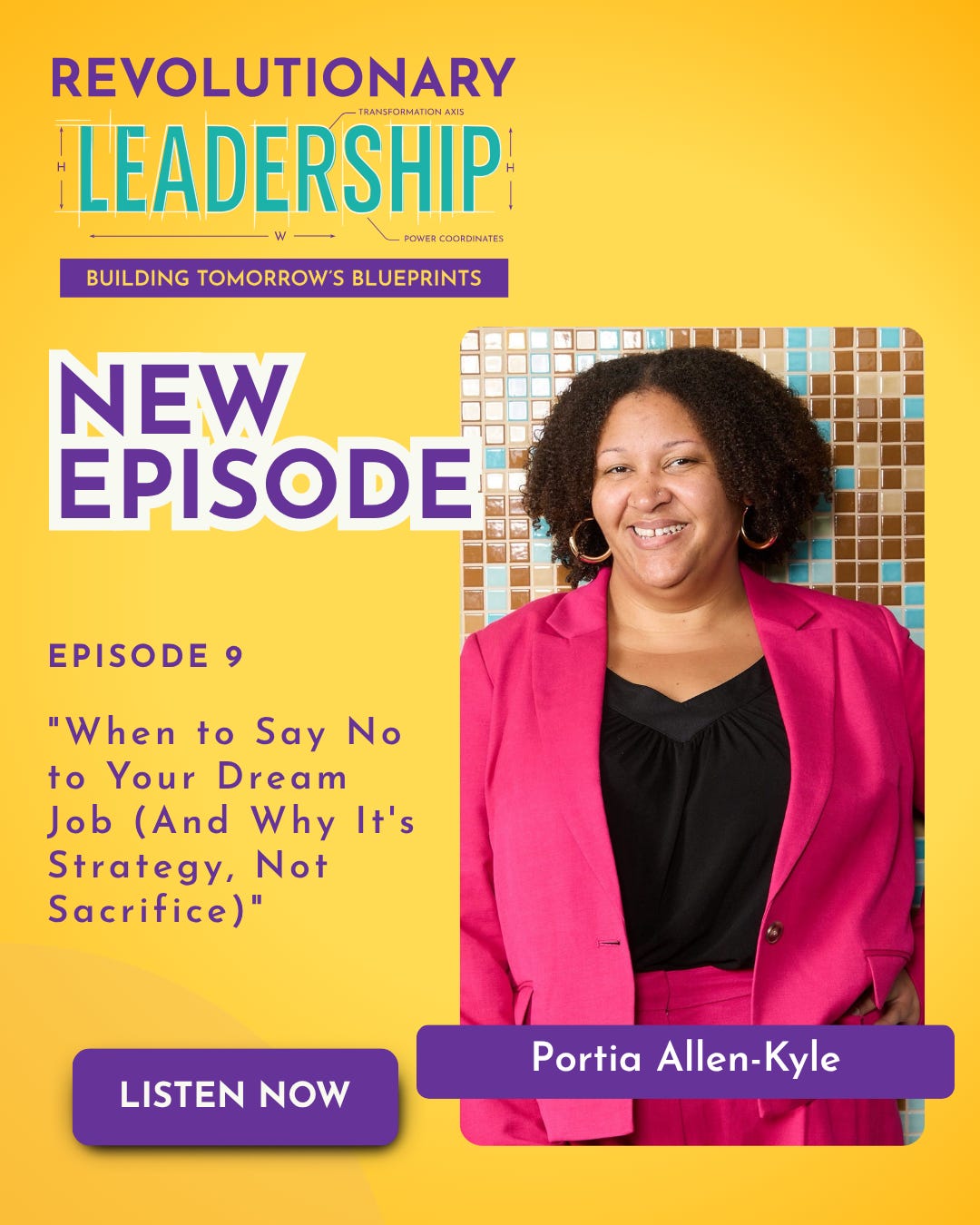
had been offered what most of the field would call a dream job.
She turned it down.
The decision was not hard. The clarity was already there.
In Episode 9, Portia walks through how she arrived at that clarity — and why Black women cannot exit, decline, or ascend the way everyone else does.
Portia is a civil rights attorney, strategist, and organizational architect. She is the interim Executive Director of Color Of Change, the largest civil rights organization in the country. She served as Senior Advisor to the Office of Civil Rights at the U.S. Department of Transportation in the Biden-Harris administration. She is the founder of FuturaBold and the author of the forthcoming book From Write-Offs to Riches: How Tax Policy Perpetuates the Racial Wealth Gap and Undermines Our Democracy.
Saying no to the dream job is not the absence of ambition. It is the highest form of strategic clarity available to a Black woman leader.
She also runs a Substack called that started after one particular week in June 2013, in the wake of Trayvon Martin and Fisher v. Texas, when she realized how much political and ideological work gets done in the everyday, mundane interactions we either challenge or reinforce.
This episode is dense. We cover six frameworks. The conversation rewards a slow listen.
The frameworks Portia named
Portia introduced six frameworks across the conversation. All six matter. Three of them are the ones I want to walk through here.
1. The Intersectional Strategic Lens
Most diversity frameworks treat intersection as a burden to manage. Portia inverts it: your intersection is not a liability. It is your strategic advantage.
Black women do not show up as just women or just Black. We show up as both, all the time, in every room. That full identity gives us a vantage point most leadership frameworks do not account for. From where we stand, we see dynamics others miss. We read rooms others cannot read. We carry analysis others do not have access to.
Portia’s addition to my framing: it is not just about seeing more. It requires courage, even alongside fear, to insert that vantage point into the conversation. The lens is the strategic asset. The willingness to use it is what makes it leadership.
2. The Non-Negotiables Framework
Know your non-negotiables before the opportunity arrives.
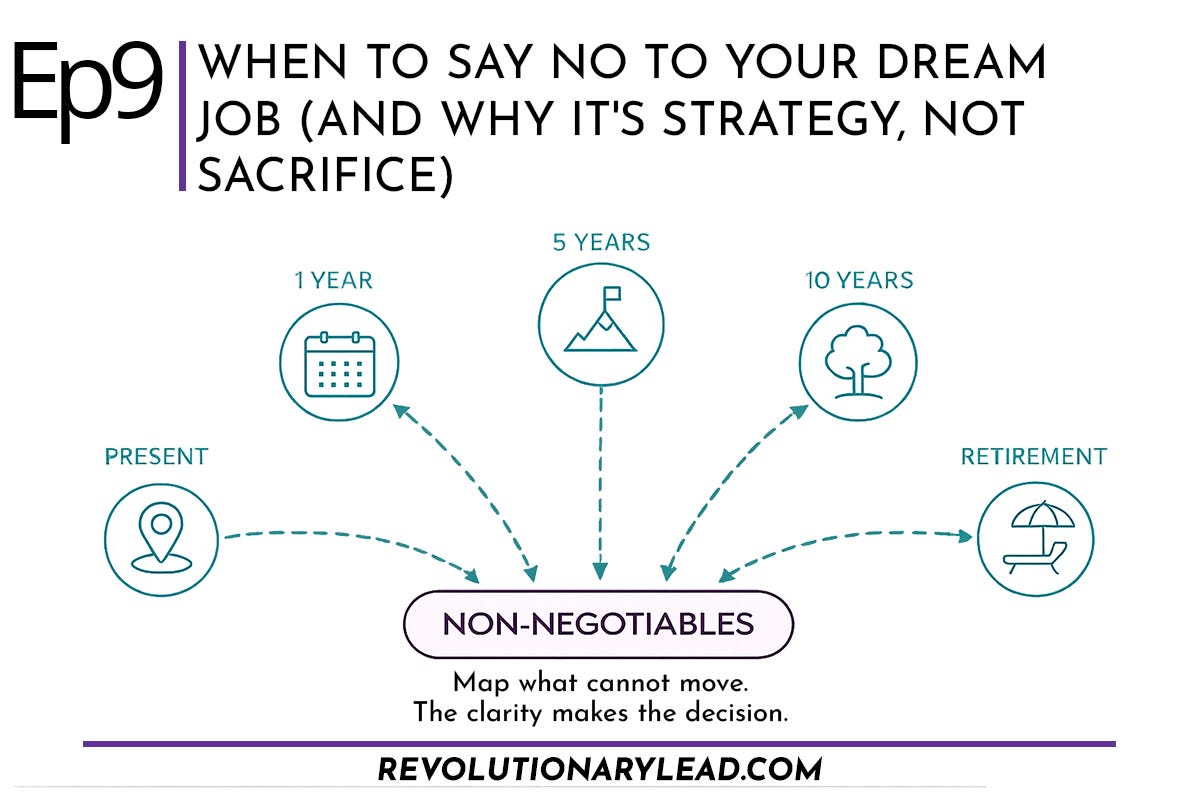
When Portia was offered the prestigious role, the decision was not hard because the clarity was already there. She had already mapped what could not move: her family, her book, her time. The role was not a complementary vision she could fit alongside what she was building. It was an alternative vision — one that would have required her to set aside what she was building.
The distinction matters. A complementary vision adds to what you are building. An alternative vision asks you to abandon it.
Portia walks through her reverse-engineering method: think one year, five years, ten years, retirement. Reverse engineer what needs to be true for all of those things. Include relationships, hobbies, goals, how you achieved them. Then pressure test with your personal board of directors — the people you can tell the hard things.
Do the mapping before the opportunity arrives. The clarity makes the decision.
3. The Strategic Exits Framework
Black women cannot exit or decline the way everyone else does.
There is emotional labor even in the leave. While we are there, we do the work. Before we get there, we do the work. As we leave, we manage people’s feelings, their perceptions of us, and the narrative about our stories.
Strategic exits require: being honest about the emotional labor involved. Getting clear about the story of the exit. Getting clear about the story of the ascension. Getting clear about the story of what comes next. Doing the internal work so it does not follow you to the next place.
Portia’s line on this: if you are not clear about all of that, people will write that story for you, and you will be a character in someone else’s vision.
You are the common denominator of wherever you go. Do the internal work before you move.
Three more frameworks named (deeper coverage in the book)
The episode also covered: the When Doors Open Framework (interrogating opportunities before walking through them), Economic Power as Leadership Infrastructure (there are no individual solutions for systemic problems), and What Breaks When Black Organizations Copy White Models. Each one earns its own future post.
Key Takeaways
-
Your intersection is not something to manage. It is the lens that lets you see what others miss.
-
Map your non-negotiables before the opportunity arrives. The clarity makes the decision.
-
Black women’s exits require strategic narrative work that nobody else has to do. Plan for it.
-
Some doors that look like up are actually lateral. Stand at the door before you walk through.
BLUEPRINT 9
Saying no is not the absence of ambition. For revolutionary leaders, the right no is often where the strategy lives.
Power Activation Prompt
Portia’s reverse-engineering exercise, adapted as the Power Activation Prompt for this episode:
Take 30 minutes this week. Write down what needs to be true for you in one year. Five years. Ten years. Retirement. Include relationships, hobbies, goals, and how you would have achieved them.
Then ask: of everything I am currently doing or considering, what supports this picture and what does not?
Take it to one person on your personal board of directors. The kind of person you can tell the hard things. Pressure test it.
When the next opportunity arrives, you will know whether it is complementary or alternative. The clarity makes the decision.
Revolutionary Leadership: A Power Playbook for Black Women publishes August 4, 2026. Pre-order at revolutionarylead.com.
Listen to the podcast on Apple Podcasts, Spotify, Amazon Music, Castbox, or YouTube.
Join The Blueprint Circle — founding membership $120 for life, capped at 100 members. After that, it closes permanently. revolutionarylead.com
Listen to the podcast
Apple Podcasts • Spotify • Amazon Music • Castbox • YouTube
Portia named six frameworks across the conversation. The episode walks through three. The deeper question underneath all of them is one most career advice does not ask: what does success actually look like for you, before someone else’s opportunity arrives to define it?
About Portia
Portia Allen-Kyle is a civil rights attorney, strategist, and organizational architect. She currently serves as Interim Executive Director of Color Of Change, the largest civil rights organization in the United States.
Previously she was Senior Advisor at the Office of Civil Rights, U.S. Department of Transportation in the Biden-Harris administration. She is the founder and principal of FuturaBold.
Her forthcoming book is From Write-Offs to Riches: How Tax Policy Perpetuates the Racial Wealth Gap and Undermines Our Democracy.
Find her: futuraboldllc.com | Substack: Why Race Still Matters | LinkedIn: Portia Allen-Kyle | Instagram and X: @ItsMsPortia
Your non-negotiables are not preferences. They are the structural conditions under which your leadership becomes sustainable instead of survivable.
My research surfaced what changes when leaders define success on their own terms before they are tested. The clarity does not just inform the next decision. It compounds across decades.
For Blueprint Circle members, the pillar Portia’s Non-Negotiables framework opens.