There is a piece of career advice that has been handed to Black women for as long as I can remember.
Find a mentor.
Find someone senior who will guide you, advocate for you, open doors for you. Build that relationship. It is your most important professional investment.
I understand why this advice feels helpful. A mentor can change a career. I have had relationships like that, and I am grateful for every one of them.
But the research tells a more complete story.
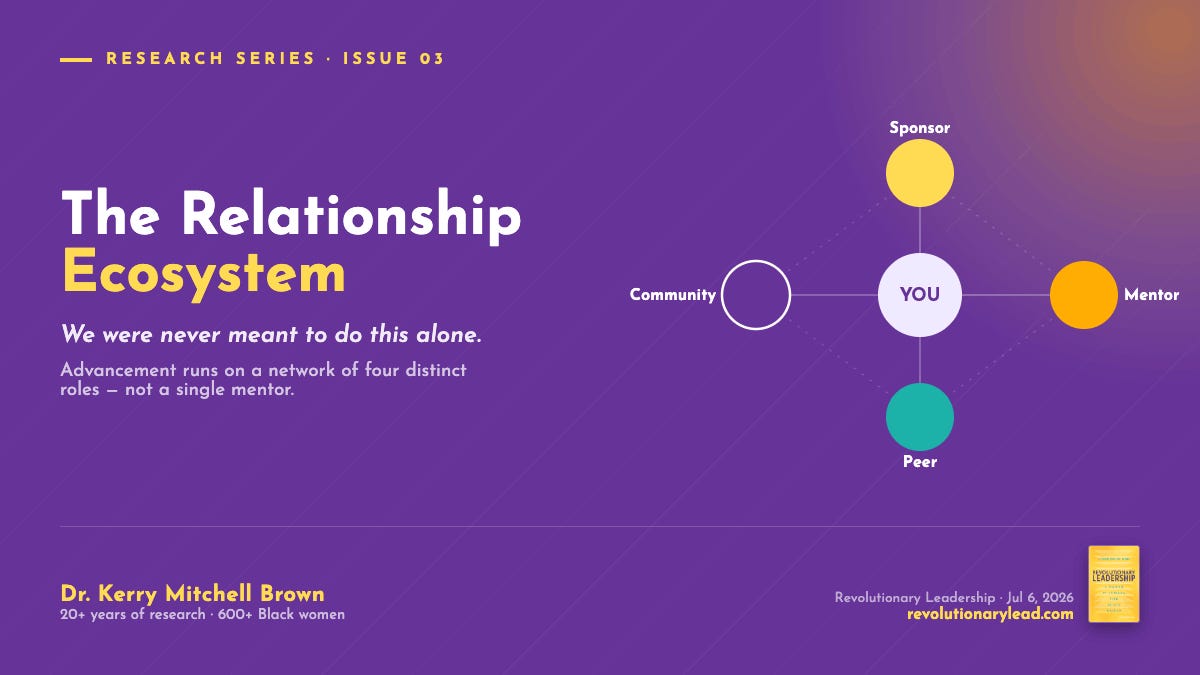
The women who advanced most consistently were not banking on one relationship. They were building ecosystems.
The Black women in my studies who advanced most consistently were not banking on a single relationship. They were building ecosystems. Distributed networks of support that spanned sponsors, peers, professional allies, and community connections — webs of relationship that created multiple pathways to opportunity rather than one guarded gate.
This was not new behavior. It was a pattern we brought with us.
We learned this in community
Black women have always understood the power of collective relationship. We learned it in churches and sororities, in mutual aid societies and neighborhood organizations, in the informal networks that held communities together when formal institutions shut us out. We built consensus by managing extended families and church committees. We created coalitions because we could not give orders and expect compliance. We invested in relationships because positional authority was rarely available to us.
The corporate world called this inefficient for decades. Now they call it inclusive leadership and pay consultants to teach it.
What my research reveals is that the community-based relationship infrastructure Black women have always built is not separate from professional advancement. It is, in many cases, what makes professional advancement possible.
The four things a single mentor cannot give you
Mentors provide guidance. They share perspective. They offer counsel born of experience. This is real and it matters. But mentorship is only one piece of what professional advancement requires.
Sponsorship is different. A sponsor advocates. They put your name in rooms you are not in. They use their own political capital on your behalf. My research consistently shows sponsorship as one of the most powerful predictors of advancement — and one of the most unevenly distributed. Sponsorship tends to follow social proximity, and social proximity tends to follow demographic similarity. This means the most powerful form of career support is also the most structurally constrained for Black women.
Peers provide something neither mentors nor sponsors can: lateral intelligence. What is the organizational temperature right now? Where are opportunities before they are formally announced? What strategies are working for people navigating similar terrain? The women in my research with strong peer networks moved through organizations with a situational awareness that made their strategic decisions more effective.
And community relationships — the ones that exist outside formal professional contexts — showed significant positive relationships with perceived success and leadership sustainability in both datasets. The women who maintained strong ties to community reported better work-life integration, more authentic leadership, and greater resilience when career conditions were difficult.
One relationship cannot do all of that. An ecosystem can.
Building the ecosystem, not the dependency
The question I encourage every Black woman I work with to ask is not: Do I have a mentor? It is: Does my relationship network have enough distribution, depth, and diversity to support my advancement, sustain my leadership, and open multiple pathways to opportunity?
That is a different inventory. It leads to different investments.
And for organizations: if sponsorship follows social proximity and your senior leadership is not demographically diverse, you have a structural problem that professional development programs cannot solve. You need explicit, accountable sponsorship structures. Not mentoring programs. Sponsorship.
Revolutionary Leadership: A Power Playbook for Black Women publishes August 4, 2026. Pre-order at revolutionarylead.com.
Listen to the podcast on Apple Podcasts, Spotify, Amazon Music, Castbox, or YouTube.
Join The Blueprint Circle — founding membership $120 for life, capped at 100 members. After that, it closes permanently. revolutionarylead.com