I want to tell you about a woman I worked with years ago.
She was talented, credentialed, and committed. She had done everything the career books say to do. She was active on panels in her industry. She published articles. She was genuinely well-known outside her organization. And she could not get promoted.
When we sat down together and looked at her situation carefully, something became clear. She was visible everywhere except where it mattered most: in the eyes of the people inside her organization who made decisions about her career. Her external profile was strong. Her internal positioning was thin.
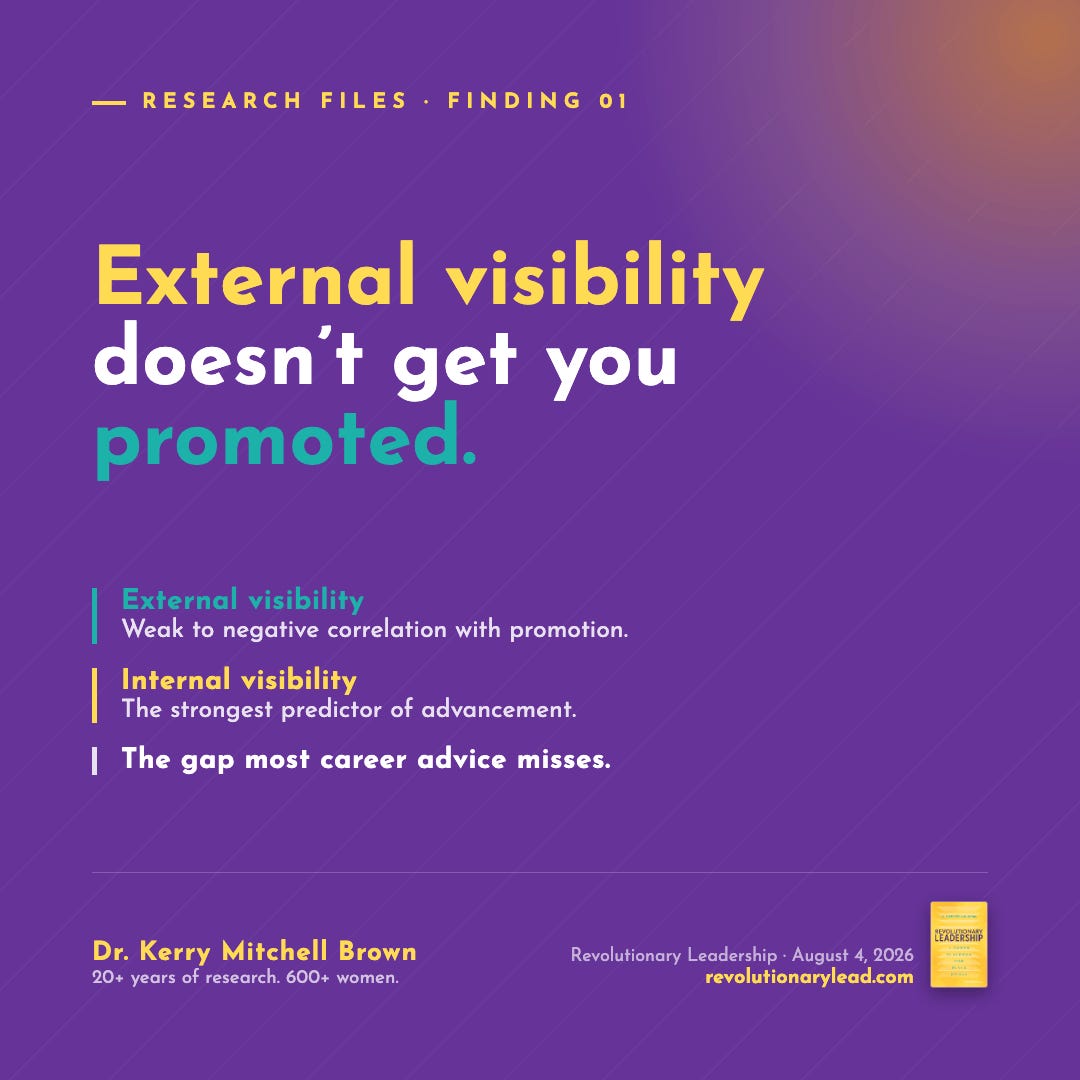
External visibility — speaking, publishing, being known outside the organization — showed weak or even negative relationships with internal promotion. Not neutral. Negative.
That experience is not unusual. It shows up in my research with striking consistency. And it has a name.
I call it the Visibility Paradox.
What the data actually shows
Across multiple regression models examining career promotion rates, serving as an external expert — speaking at conferences, publishing, being recognized outside the organization — showed weak or negative relationships with internal advancement. In several model specifications, the relationship was negative. Not neutral. Negative.
Internal visibility, by contrast — being seen by senior decision-makers doing meaningful, high-stakes work inside the organizational context — was one of the strongest and most consistent predictors of promotion across both the 2010 and 2025 datasets.
This is not a small finding. It is a challenge to one of the most persistent narratives in professional development. And I did not arrive at it easily. I looked at those results more than once before I trusted them. But they held, across different models, different specifications, different time periods. The visibility that matters for advancement is not the visibility most of us are chasing.
Why this happens
Organizations advance people they know, trust, and see solving problems that matter to them. That relationship — between a decision-maker and a potential advancement candidate — is built through proximity. Through shared high-stakes work. Through being the person a senior leader thinks of when something important needs to get done.
None of that happens from the outside.
When professional energy goes into external activities — and it takes real energy to maintain a public profile, speak at conferences, publish articles — that is energy not going toward internal positioning. For Black women navigating organizations that do not always make internal access straightforward, this tradeoff carries real stakes.
I am not saying external visibility is worthless. I have built a public platform and I believe in its value — for thought leadership, for the work of reaching people this research needs to reach. But the question I ask now, and the question I encourage every Black woman I work with to ask, is a simple one: Who needs to see this? And is that the same person who makes decisions about my advancement?
Internal visibility — being seen by the decision-makers inside your organization — was one of the strongest predictors of advancement across both studies.
Revolutionary Visibility looks different
The Revolutionary Leadership approach to visibility is not about retreating from public presence. It is about precision.
It asks: Who are the decision-makers in my specific organizational context? Are they aware of my contributions? Am I on the high-impact work — the projects that matter to the people who determine careers? Am I building genuine relationships with the people who have influence over my next opportunity? Black women have practiced this kind of strategic precision for generations. The women who organized through the church, who built the sororities, who carried the civil rights movement — they read rooms with the seriousness of people whose access was never guaranteed. The vocabulary is new. The practice runs back through everything we inherited.
These are not glamorous questions. They do not generate LinkedIn engagement. But they are the questions the data suggests are worth asking first, before we invest hours in the activities that feel most like visible leadership but are least connected to actual advancement.
The women in my research who advanced consistently had a kind of strategic clarity about this. They were not the most externally recognized. They were the most intentionally positioned. And there is a meaningful difference between those two things.
Revolutionary Leadership: A Power Playbook for Black Women publishes August 4, 2026. Pre-order at revolutionarylead.com.
Listen to the podcast on Apple Podcasts, Spotify, Amazon Music, Castbox, or YouTube.
Join The Blueprint Circle — founding membership $120 for life, capped at 100 members. After that, it closes permanently. revolutionarylead.com