Mills was a school therapist for seven years. K-12. Children with social, emotional, and behavioral needs. The work was hard and the pattern was clear.
When the adults in the building were burned out, it trickled down to the kids.
Not as a metaphor. As a clinical observation. The depleted teacher shaped the dysregulated classroom. The exhausted principal shaped the brittle staff culture. The overwhelmed administrator shaped what got prioritized and what got dropped.
Mills started Motivating Minds Mental Health Counseling because the individual interventions she could offer in school were not enough. The conditions producing the depletion were structural. Helping individuals survive a broken system was not the same as building a system that did not break people in the first place.
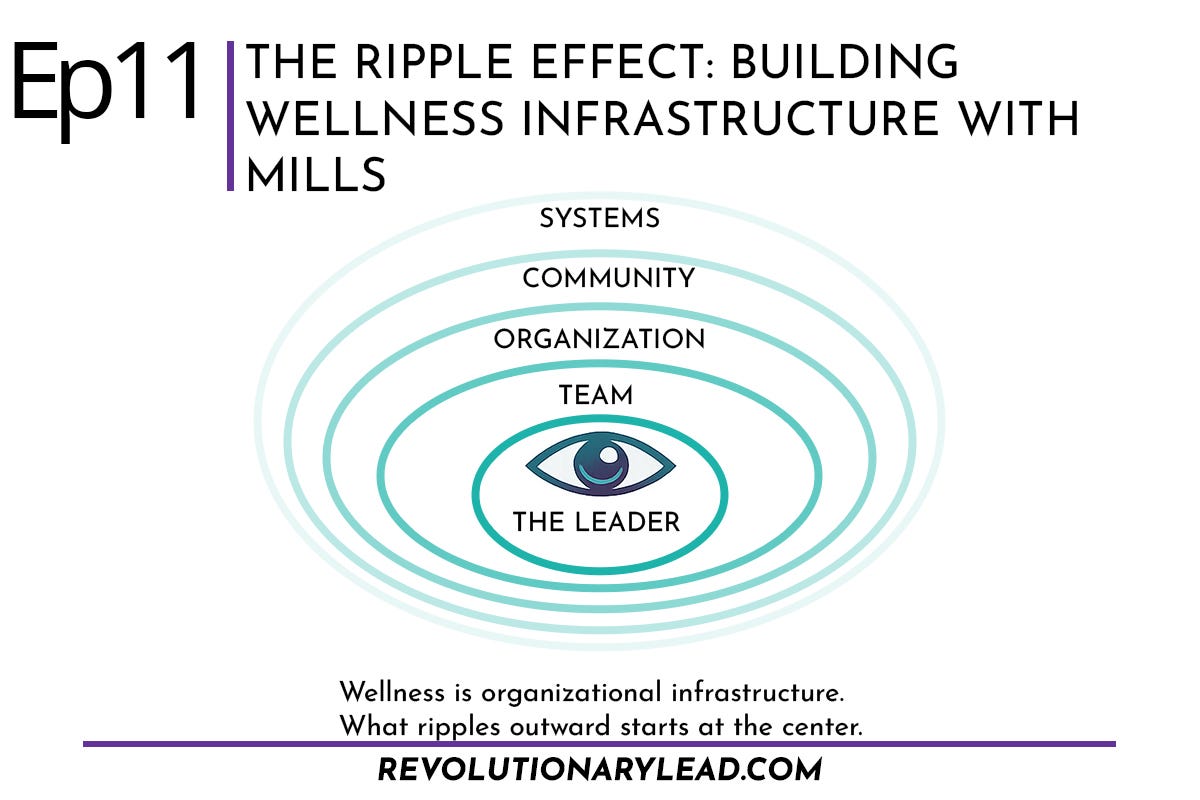
The depletion cascades structurally. The leader’s state becomes the conditions everyone else operates inside.
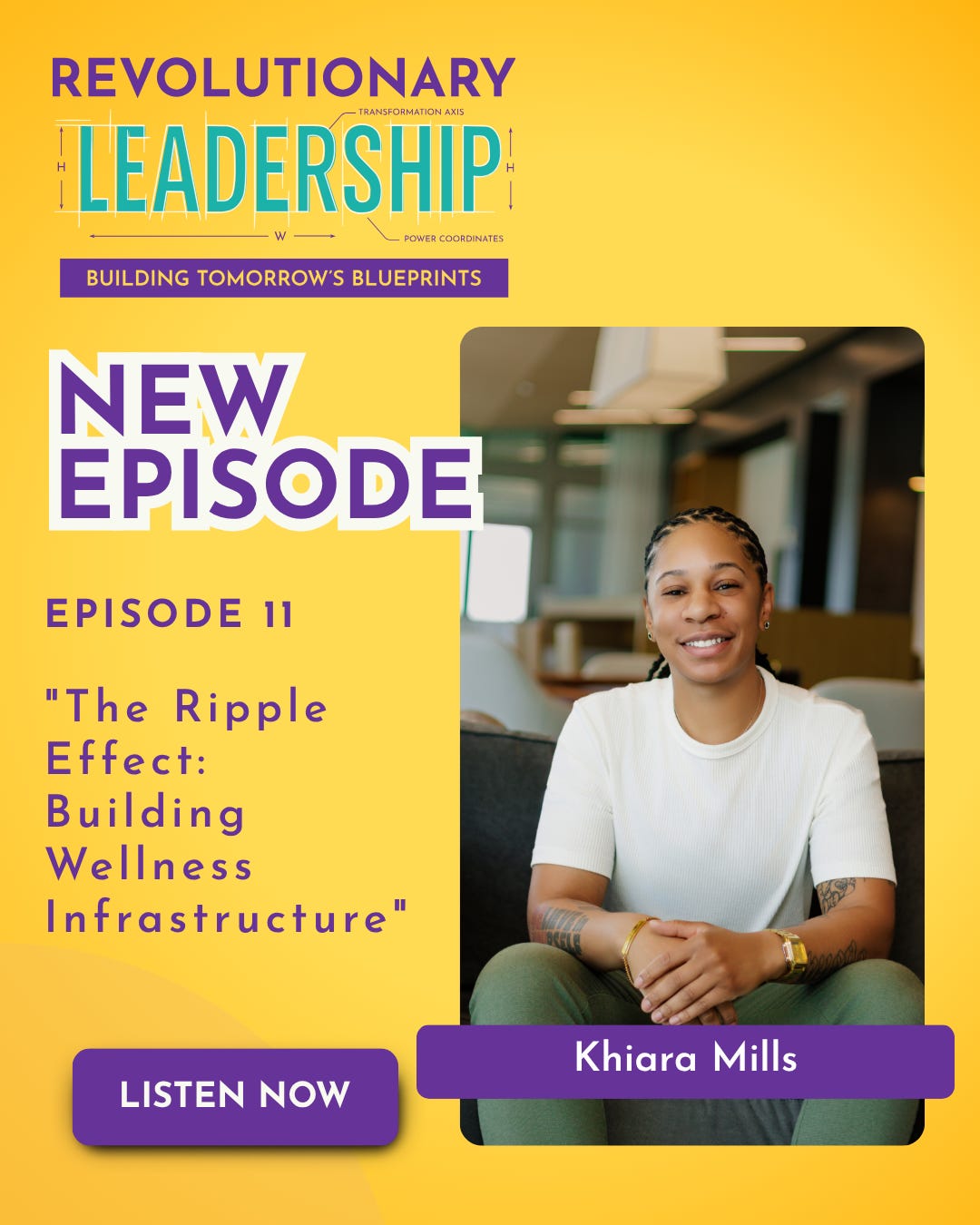
On Episode 11, Mills walks through what wellness infrastructure actually looks like. And why Black women leaders are often the ones building it whether or not anyone has asked them to.
This episode is the second half of a conversation that started in Episode 8 with Dr. Zakiya Newland. Episode 8 asked: how do I protect MY peace? Episode 11 asks: how do I build wellness infrastructure so EVERYONE I serve can thrive?
The frameworks Mills named
Mills introduced four frameworks across the conversation. All four matter. Two of them are the ones I want to walk through here.
1. The Ripple Effect Principle
Adult wellness, or depletion, directly impacts everyone in their sphere of influence.
Mills observed it first in schools. The same pattern shows up in corporate teams, nonprofits, healthcare systems, and any environment where leaders serve others. When leaders are running on empty, the people they serve absorb the cost.
The shift Mills calls for: stop treating individual symptoms of burnout. Address the conditions that produce depletion in the first place.
Leaders must recognize that their wellness is not personal. It is organizational infrastructure. The leader who refuses to model rest is not just exhausted — she is shaping a culture where everyone she leads is also exhausted, on a delay, and at scale.
2. Core Values Alignment Framework
Mills’ foundational approach with every client, regardless of setting. Not after a few sessions. The first session.
Her metaphor: if you are unaware of what your core values are, just think of it as navigating a foreign country without a GPS. You are just navigating your day to day with no guidance.
The process is four moves. Identify your core values. Define your healthier self — what does thriving look like for you specifically. Align daily decisions with those values. Create non-negotiables that eliminate the conditions of self-sacrifice.
The insight that does the most work: values change depending on life phases and experiences. Regular reassessment is required. The values that anchored you at 30 may not be the ones that anchor you at 50. The map updates.
Why it works: when people operate from a regulated nervous system and know their values, they make aligned decisions sustainably. Without that foundation, decision-making is reactive — a series of corrections rather than a clear path.
Two more frameworks named
The episode also covered: the 80/20 Accountability Model (the guide provides 20 percent in tools and strategies; the client’s consistent implementation is the 80 percent), and Nervous System Regulation as Foundation (her specialized work with Brain Spotting — a mind-body therapy that addresses where stress is stored rather than just where it is understood). Both deserve their own future treatment.
Key Takeaways
-
Your wellness as a leader is not personal. It is organizational infrastructure.
-
Without a regulated nervous system, sustainable decision-making is not possible. Regulation comes first.
-
Core values change. Regular reassessment is required, not optional.
-
Self-sacrifice is not a requirement for impact. Depletion is not dedication.
Wellness as personal practice is not enough. Wellness as organizational infrastructure is the work.
BLUEPRINT 11
Self sacrifice is not a requirement for impact. For revolutionary leaders, regulation is not personal maintenance. It is the infrastructure everyone you lead depends on.
Power Activation Prompt
Mills’ first-step practice, adapted as the Power Activation Prompt for this episode:
Pause long enough to notice how your body feels.
Right now. Before you scroll to the next thing.
What is your nervous system actually telling you about the conditions of your work, your week, your year?
Then identify three core values. Not aspirational ones. Actual ones — the ones your daily decisions already reveal.
Where are your daily decisions in alignment with those values? Where are they not? That gap is the work.
Revolutionary Leadership: A Power Playbook for Black Women publishes August 4, 2026. Pre-order at revolutionarylead.com.
Listen to the podcast on Apple Podcasts, Spotify, Amazon Music, Castbox, or YouTube.
Join The Blueprint Circle — founding membership $120 for life, capped at 100 members. After that, it closes permanently. revolutionarylead.com
About Mills
Khiara Mills, LCPC-NCC, is the founder of Motivating Minds Mental Health Counseling. She specializes in nervous system regulation and Brain Spotting — a mind-body therapy that addresses stored stress and trauma at the level of the nervous system rather than only at the level of cognition.
She was a school therapist from 2016 to 2023, working with K-12 students with social, emotional, and behavioral needs. She started her private practice in 2022 and went full-time in 2023.
She is a member of Black in Business, Cohort 8.
Find her: Instagram @_motivatingmills and @motivatingmindsmhc | LinkedIn: Khiara Mills | Workshops and cohorts: msha.ke/motivatingmills
Listen to the podcast
Apple Podcasts • Spotify • Amazon Music • Castbox • YouTube
Mills closes a three-part arc that runs through Episodes 7, 8, and 11. Burnout as information. Peace as infrastructure. Wellness as organizational architecture. Each episode treats the same pillar from a different scope — individual signal, personal positioning, systemic design.
My research has been building toward the systemic frame Mills names. The pattern shows up clearly: leader wellness is not personal. It is the operating condition of everyone the leader serves.
For Blueprint Circle members, the structural reframe.