I remember the day someone told me, “That was great. Nobody believed you would be able to do it. Now you have a target on your chest.”
I had done the work I was hired to do. I felt good about it. The praise came with a warning.
So I asked who was going to shield me from whatever came next.
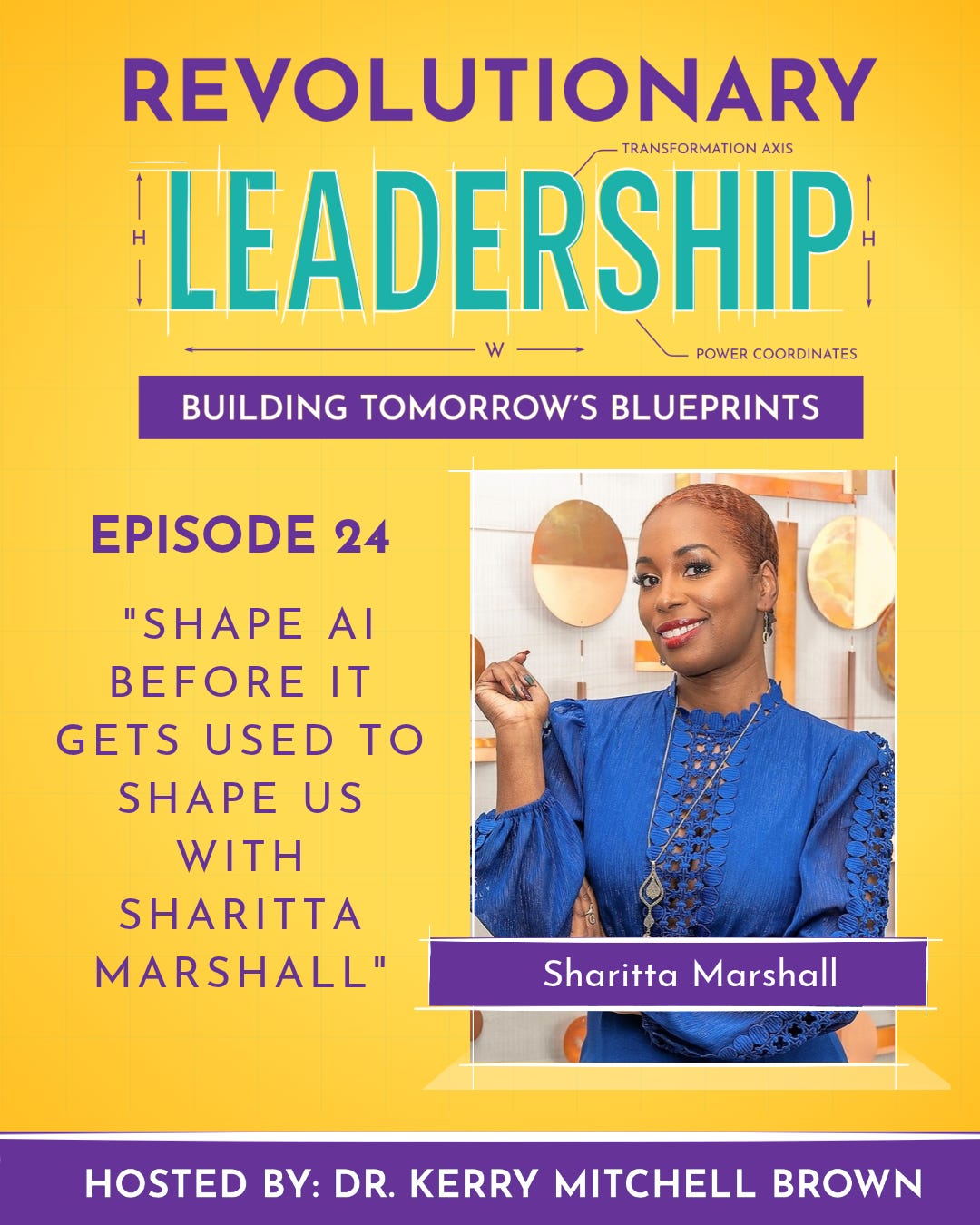
Sharitta Marshall of knows that moment. She has a name for it.
Pet to threat.
The unicorn and the target
Here is how she describes it. We are brought in as the magical unicorn, the great addition to the team. Then we do the work, or we push to do it, and we become the problem.
She puts it plainly. “We get that bullseye, not even on our back, but on our forehead.”
That is not a personal failing. It is a pattern, and it is the one I introduced in Episode 1 of this podcast as the savior-scapegoat trap. Black women get positioned to fix everything, then get blamed when it does not happen overnight, inside systems never built for our success.
Sharitta lived this pattern. It led to her separation from her former employer. She has since built more than two dozen AI systems and equipped more than 400 leaders at organizations including Alstom, IKEA, PagerDuty, Apex Systems, the Las Vegas Raiders, WICT Network, and Clarins.
When I asked what she knows now, she did not start with technology. She started with the system.
Find the right problem first
Most organizations adopt AI before they confirm what problem they are solving.
Sharitta built the Source Protocol for that gap. It has five steps.
Locate. Name the actual problem. “More efficiency” is not a problem.
Diagnose. Solving one problem with technology creates another. Plan for it.
Stress. Pilot it. Build in governance before you scale.
Build. Only now do you build. She calls it carpentry. Measure twice, cut once.
Translate. Tell leadership, and tell the people doing the work. Where do they fit? Are they part of this or pushed out by it?
That last step is where I leaned in. Most people are ready for change. What unsettles them is not knowing how it touches their role. That is change management, and it is the part organizations skip.
AI literacy is self-protection
Sharitta does not treat AI as a technical hobby. She treats it as protection.
Her argument is direct. If Black women do not understand AI at a fundamental level, we risk building our own digital oppressor, one system at a time.
She is clear that AI is a tool. What matters is who is behind it, how they build it, why they build it, and what they are willing to ignore.
Who is building the data centers in our communities
Early in our conversation she said the large language models are not the only reason data centers are going up the way they are. I told her we were coming back to that. We did.
She shared a number from her co-host Ella Nance’s research. About 15 percent of the data in U.S. data centers is large language model data. The rest is the bank app, the streaming service, the insurance and medical algorithms, the chatbot on a website, the cameras on the road. That is her co-host’s research, and Sharitta asks every listener to check the facts for themselves.
She also describes developers buying cheap land, capturing tax benefits, and then building centers to sell or lease. By the time a community hears about one, she says, the process is often two years old.
Her answer is to get proactive and push back. “It’s only absolute if you never actually try anything.”
She also names a pattern many of us know. The land is cheaper in lower-income communities, and she says the burden falls hardest on Black, low-income, and rural neighborhoods.
Where to start, in her words:
-
NAACP Center for Environmental and Climate Justice, for community playbooks and community benefit agreement templates
-
Capital B News
-
Climate Justice Alliance
-
MediaJustice.org
-
Earthjustice
-
Southern Environmental Law Center
Her first advice is to listen to Black women working in AI, and then do your own research.
Your work will not speak for itself
I asked where she learned that documenting your work out loud was survival, not self-promotion.
She learned it the hard way. She watched someone who did less than half of what she did get the opportunity, because that person was in the room every day. She does not want to be in anyone’s face all the time. She wants her work to be.
That is documentation as infrastructure. In Chapter 17 of my book, I write about Marion Stokes, who recorded more than 70,000 tapes because she did not trust the official record. She did not just recognize that something was important. She built the system to preserve it.
You can do a version of that this week.
Write down what you did. Say it out loud. Make it undeniable.
What I am carrying from this conversation
Three things.
Name the system instead of internalizing it. The target was built for you. You did not earn it.
AI literacy is self-protection. Understanding it is the first step. Shaping it is the second.
Documentation is infrastructure. It carries you into the next room.
And here is Sharitta’s answer to the question every guest this season answers. What do you know now that a leader who comes after you will need to hear?
“You have the responsibility to see your team as human beings, but also to push them to see themselves as the best version that they could possibly be.”
Sharitta Marshall
Listen to the full conversation
Shape AI Before It Gets Used to Shape Us with Sharitta Marshall is live now!
Wherever you get your podcasts, or at revolutionarylead.com.
Apple Podcasts • Spotify • Amazon Music • Castbox • YouTube
Where to find Sharitta
-
Substack
-
LinkedIn: linkedin.com/in/sharittamarshallmba
-
SpeakerHub: speakerhub.com/speaker/sharitta-marshall
-
Corporate: visionarydevelopmentinc.com
-
Impact Weaver App: impactweaverapp.com
Sharitta is available for speaking engagements and executive AI training. Her book, The Unwritten Rules Are Meant to Be Broken, is available now.
Lead with Power. Lead with Care. Change Everything.
Revolutionary Leadership: A Power Playbook for Black Women available now at revolutionarylead.com.
Listen to the podcast on Apple Podcasts, Spotify, Amazon Music, Castbox, or YouTube.
Join The Blueprint Circle — founding membership $120 for life, capped at 100 members. After that, it closes permanently. revolutionarylead.com