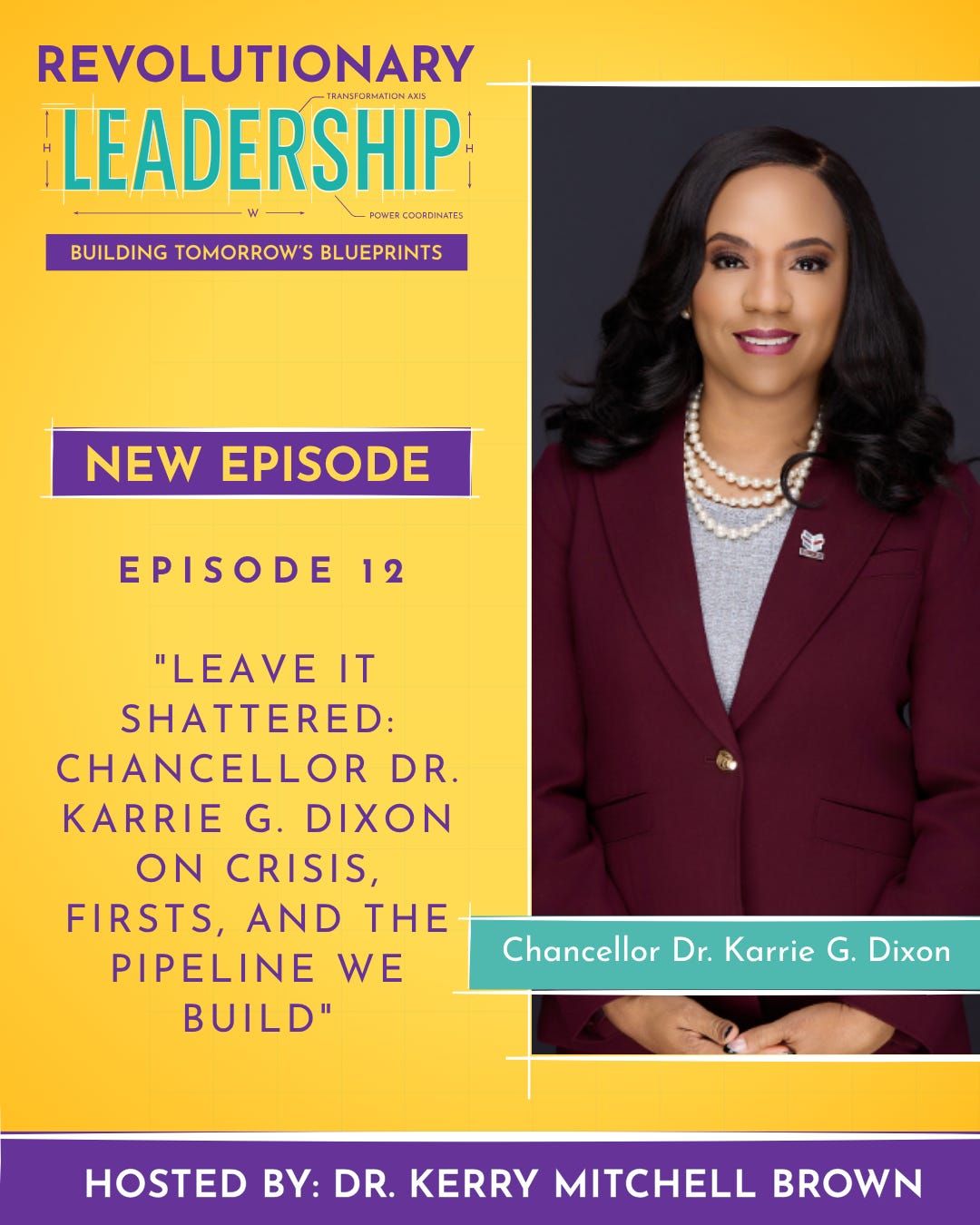
Chancellor Dr. Karrie G. Dixon leads North Carolina Central University (NCCU) — the first woman to lead two public universities in the UNC System. She came into the role at a moment of institutional vulnerability and executed one of the most significant HBCU transformations in recent memory. In this conversation, she breaks down the methodology — not as inspiration, but as a repeatable framework for institutional leadership in high-stakes moments. And she names what it means to be first: not a personal milestone, but a structural decision about who comes through behind you.
The frameworks Dixon named
Chancellor Dixon introduced six frameworks across the conversation. All six matter. Three of them are the ones I want to walk through here.
1. Leave It Shattered: First as Infrastructure
Chancellor Dixon’s reframe of what it means to be the first woman in an institutional leadership role.
“When you break the glass ceiling, leave it shattered — because we have to bring other women through that shattered ceiling.”
Being first is not a personal achievement. It is a structural design decision. The leader who breaks the ceiling has a choice: claim the accomplishment as personal, or use it as the foundation for the next woman’s entry.
Dixon connected this directly to HBCU governance and the Black church — institutions Black communities built when dominant ones refused us entry — and named that some trustees hiring chancellors and presidents still carry assumptions that women should not lead. In 2026, Black women are still becoming firsts.
Every structural barrier you break is infrastructure you can leave standing or shattered. The choice you make in that moment determines whether your leadership is individual or generational.
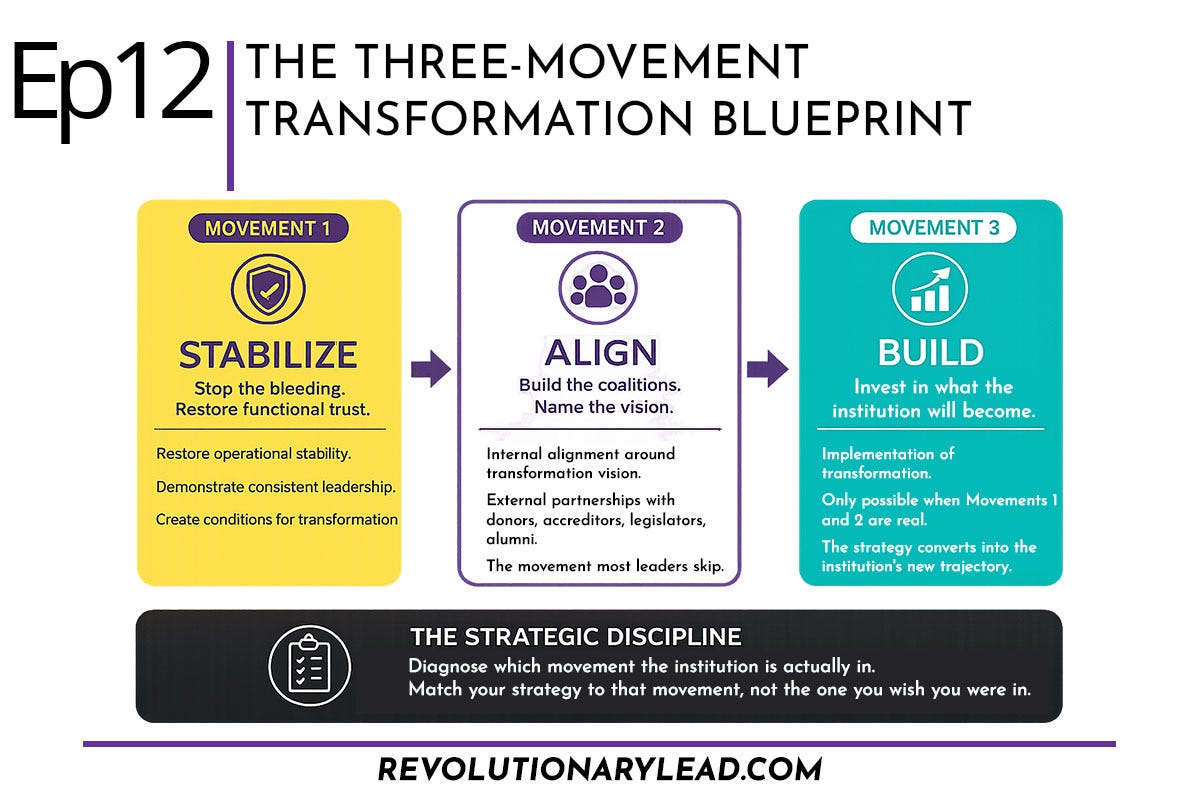
2. The Three-Movement Transformation Blueprint
A sequenced framework for institutional turnaround drawn from Chancellor Dixon’s lived practice at Elizabeth City State University and now at NCCU.
Movement 1 — Stabilize. Stop the bleeding. Restore functional trust. Establish that there is a steady hand. Strategy at this stage is consistency, transparency, and demonstrating operational competence. The work is not transformation yet. It is creating the conditions for transformation to be possible.
Movement 2 — Align. Build the coalitions. Internal alignment around the transformation vision. External alignment with the partners, donors, legislators, and accreditors whose support the transformation requires. Most leaders skip this movement because it looks like talking instead of doing. Skipping it is what makes Movement 3 collapse.
Movement 3 — Build. Invest in what the institution will become, not just what it currently is. This is where the access converts into the institution’s new trajectory. Only possible when Movements 1 and 2 are real.
The strategic discipline is diagnosing which movement you are actually in — and matching your strategy to it, not to the movement you wish you were in. If your strategy is Movement 3 (visionary investment) but the institution is still in Movement 1 (broken trust), the strategy will fail. Not because the vision is wrong, but because the conditions are not yet built.
3. The Mentor-Sponsor Distinction
A precise framework for understanding the difference between two types of relationships that are often conflated.
A mentor advises you. Is present in conversations with you. Guides your development across personal and professional landscapes. A sponsor acts on your behalf. Is in rooms and conversations you are not in. Waves your flag. Says your name when decisions are being made.
Dixon’s exact words: “They are in rooms and in conversations that women are not — waving your flag, helping folks understand: have you heard about her? She would be great for this.”
The honest observation she named: most of her sponsors have been men, because higher education leadership is still male-dominated. She navigated this deliberately — kept relationships professional, clearly communicated her goals, and let them be her champions in rooms she was not in.
Black women in leadership are most starved not for mentors, but for sponsors. Identify who in your network is in decision-making rooms on your behalf. If you cannot name them, that is the work.
Three more frameworks named (deeper coverage in the book)
The episode also covered: Opportunity DNA Sequencing (her method for reading institutional contexts the way a strategist reads a landscape — identifying what is possible, what is expensive, and what is already aligned before making the first move), Negotiation as Leadership Infrastructure (practicing self-advocacy in low-stakes environments before the stakes are high), and Collective Capacity-Building Over Individual Heroism (deliberately surrounding herself with people who challenged her perspective rather than echoed consensus). These get deeper treatment in Revolutionary Leadership: A Power Playbook for Black Women.
Key Takeaways
-
The Three-Movement Blueprint: Movement 1 — Stabilize (stop the bleeding, restore functional trust). Movement 2 — Align (build internal and external coalitions around a specific transformation vision). Movement 3 — Build (invest in what the institution will become, not just what it is).
-
Opportunity DNA Sequencing: Chancellor Dixon reads institutional contexts the way a geneticist reads a genome — identifying the strategic code that determines what’s possible, what’s expensive, and what’s actually already aligned with her vision.
-
Collective Capacity-Building: Institutional leadership is not individual heroism. It is distributed responsibility across faculty, staff, students, alumni, and external partners. The leader’s job is to design the conditions in which collective capacity can emerge.
-
Refusing the Savior-Scapegoat Trap at Institutional Scale: She is neither going to rescue the institution single-handedly nor absorb the blame for structural conditions that predated her. Revolutionary leadership at this scale looks like boundaried, visionary accountability.
-
NCCU as Pipeline and Proof Point: The work at NCCU is also a demonstration project for what’s possible at HBCUs more broadly — that institutional revival grounded in community care can succeed and scale.
Leave It Shattered — First as Infrastructure: Chancellor Dixon’s reframe of being the first woman in a role. “When you break the glass ceiling, leave it shattered — because we have to bring other women through that shattered ceiling.” Being first is not a personal achievement. It is a structural design decision: claim the accomplishment as personal, or use it as the foundation for the next woman’s entry. She connected this to HBCU governance and the Black church — institutions Black communities built when dominant ones refused entry — and named that some trustees still carry assumptions that women should not lead.
Some trustees who are hiring chancellors and presidents still have in their minds that women should not lead.
The Mentor-Sponsor Distinction: A mentor advises you and is present in conversations with you. A sponsor acts on your behalf in rooms you are not in — waving your flag, saying your name when decisions are made. Chancellor Dixon’s observation: Black women in leadership are most starved not for mentors, but for sponsors. If you cannot name who is in decision-making rooms on your behalf, that is the work.
BLUEPRINT 12
Crisis is not the interruption of institutional leadership. For revolutionary leaders, crisis is often where the transformation lives.
Power Activation Prompt
What institution, team, or system are you currently leading — including one you are leading from inside without formal authority? Which movement are you actually in: Stabilize, Align, or Build? And is your current strategy matched to that movement — or to the movement you wish you were in?
Revolutionary Leadership: A Power Playbook for Black Women publishes August 4, 2026. Pre-order at revolutionarylead.com.
Listen to the podcast on Apple Podcasts, Spotify, Amazon Music, Castbox, or YouTube.
Join The Blueprint Circle — founding membership $120 for life, capped at 100 members. After that, it closes permanently. revolutionarylead.com
About Dr. Dixon
Chancellor Dr. Karrie G. Dixon is the 13th Chancellor of North Carolina Central University, appointed July 1, 2024. She is the first woman to lead two UNC System public universities in North Carolina, and the second woman Chancellor in NCCU’s history.
Prior to NCCU, she served as Chancellor of Elizabeth City State University, where she led the institution from crisis (17 audit findings, 60 percent enrollment decline, accreditation warning status, five Chancellors in five years) to nearly 70 percent enrollment growth and significant public and private investment.
At NCCU (18 months in): record enrollment surpassing 9,000 students for the first time in history, highest percentage enrollment growth in the UNC System for the second consecutive year, first HBCU to establish an AI institute, first clean audit in three years.
She has over 20 years in the UNC System, including more than a decade at the system office working across all 17 constituent institutions. She became Chancellor of ECSU at age 43.
Find her: Instagram/Facebook @EagleInChief13 | LinkedIn: Chancellor Dr. Karrie G. Dixon | NCCU profile: nccu.edu/employee/karrie-g-dixon
Listen to the podcast
Apple Podcasts • Spotify • Amazon Music • Castbox • YouTube
Chancellor Dixon names something most institutional leadership advice misses entirely. Stabilization is not the goal. Stabilization is the precondition for the transformation. Most leaders inheriting institutions in crisis stop at Movement 1 — restore the trust, stop the bleeding, hold the line. The transformation never comes.
My research has been documenting what changes when leaders treat Access to Power as institutional architecture rather than individual positioning. The pattern shows up at every scale.
For Blueprint Circle members, the pillar at institutional scope.