Dr. Brooke Douglas spent more than five years at a federal public health agency. She managed a 10 million dollar federal grant portfolio across violence prevention and health equity programs. Fourteen federally funded partners. Eight jurisdictions. Full lifecycle ownership from design through compliance and evaluation.
In April 2025, she was caught in a reduction-in-force. By August, she was officially separated. She has been searching for nearly a year.
She is one of approximately 300,000 to 350,000 Black women who lost their jobs across all sectors in 2025. Federal government. Private sector. Nonprofit. The federal cuts alone reached 277,000 jobs — and Black women, who make up 12 percent of the federal workforce, were disproportionately affected. Professional services. Healthcare. Manufacturing. The losses ran through every sector.
Black women’s unemployment hit 7.5 percent in September 2025. The highest in four years. It remained at 7.1 percent in February 2026. Nearly double the 3.4 percent rate for white women.
College-educated Black women saw their employment rate fall from 74 percent to 71 percent in nine months. White women with bachelor’s degrees dropped less than one point in the same window.
And amid private-sector DEI rollbacks, qualified women are removing entire sections from their resumes and leaving race unidentifiable on applications to avoid being screened out.
Episode 13 is about what Brooke built to keep moving inside that labor market. A framework. Not a coping mechanism. Translation as survival infrastructure.
The frameworks Brooke named
Brooke walked through four frameworks across the conversation. The first one — The Translation Framework — is the architecture of the episode and is documented in Revolutionary Leadership: A Power Playbook for Black Women (August 4, 2026). All four matter. Three are the ones I want to walk through here.
1. The Translation Framework
When the labor market stops being able to read your resume, the answer is not to work harder or apply wider. It is to change the language.
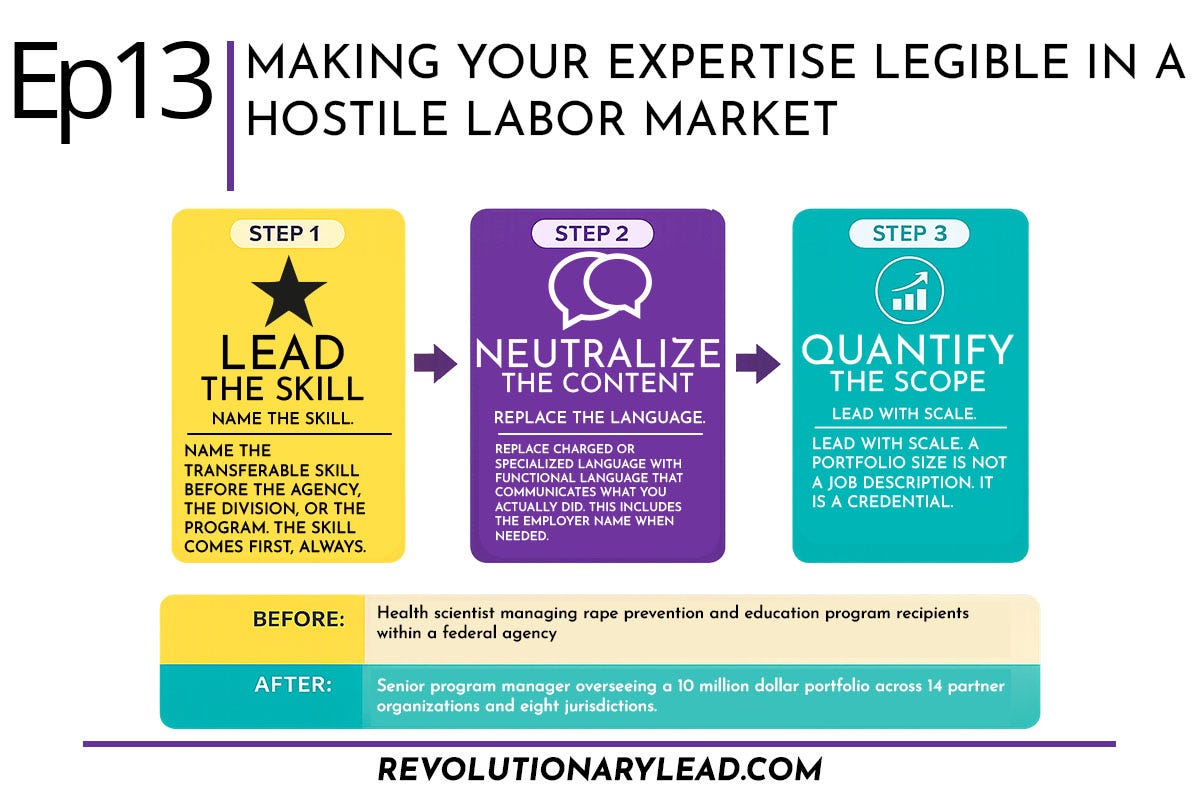
The framework has three steps.
Step 1 — Lead the skill. Before you name the agency, the division, the program, or the organization, you name the transferable skill. Not ‘I worked for a federal public health agency,’ but ‘I am a senior program manager with more than five years of experience leading multi-million-dollar public health initiatives.’ The skill comes first. Always.
Step 2 — Neutralize the content. Replace language that creates friction, that is politically charged, or that triggers a reaction before someone can evaluate you, with functional language that communicates what you actually did. Not ‘rape prevention and education recipients,’ but ‘federally funded community-based prevention program partners.’ Same work. Same scope. Now legible. This step extends to the employer itself. Brooke chose to say ‘federal public health agency’ rather than name the institution, to protect both her safety and the mission. That is not hiding. That is strategy.
Step 3 — Quantify the scope. Lead with scale. A 10 million dollar portfolio. 14 partner organizations. Eight jurisdictions. That is not a job description. It is a credential. When you lead with the numbers, the reader immediately understands you managed complexity, worked at scale, and held seniority.
Translation is not a resume trick. It is survival infrastructure. If your skills cannot be heard, they cannot be valued. That is a translation problem, not a capacity problem.
2. Accepting Help as Architecture
Across my practice, more Black women are saying ‘I need help’ for the first time. The pattern is consistent. The shame is consistent. And the framing that has to shift is consistent.
Asking for help is not evidence that something went wrong. It is preparation for what is next. It is not a concession. It is architecture.
Black women have operated within mutual aid ecosystems long before networking had a name. The infrastructure has always been there. What is changing is whether we are willing to call on it openly.
3. No as a Reset
Drawing on the framework from Episode 5, a no does not always mean not you. Sometimes it means not that role. Not that vision. Not right now.
The nos Brooke received over the past year were not the end of her story. Some of them sent her back to the drawing board in ways that opened doors she had not been looking at. What looks like an ending is often a redirect toward something more aligned.
This connects directly to Brooke’s other thread on sustainability: she is an introvert who spent years in heavy, external-facing relationship management. The realization that she wanted something more sustainable is not a failure of ambition. It is information. Asking whether a role is sustainable for you specifically is not being picky. It is being strategic about your own capacity as a leader.
One more framework named (deeper coverage in the book)
The episode also covered: Translation as Resistance — the recognition that translating language tied to work you believed in is hard, and that doing it anyway is both survival and resistance. Brooke names this from her own location: coming from violence prevention work, translating that work is challenging. She sees it as a way to keep doing the work she loves while getting through doors that were being closed. Deeper coverage in Revolutionary Leadership: A Power Playbook for Black Women.
Key Takeaways
-
Language is infrastructure. If your skills cannot be heard, they cannot be valued. That is a translation problem, not a capacity problem.
-
Lead the skill, not the institution. Quantify scope. Neutralize content. Translation has three steps and a sequence.
-
No can be a reset. The nos that send you back to the drawing board are often redirects toward something more aligned.
-
Accepting help is a strategy. It is not from deficiency. It is preparing you for what is next.
-
What Brooke experienced was systemic. 350,000-plus Black women, same moment, same labor market. The response to a systemic crisis is collective strategy, not private shame.
BLUEPRINT 13
Career transition is not a pause in your leadership story. It is a chapter in it. How you navigate it becomes part of the blueprint.
Power Activation Prompt
Audit your resume.
Look at every power statement. Ask: am I leading with the skill or the institution?
If you are leading with the institution, rewrite the line. Skill first. Scope second. Quantify the scale.
Then pick one section where the language carries political friction or sector-specific framing that may not land in the markets you are now applying to. Translate it. Same work. Same scope. Different language.
If this audit surfaces that you do not have anyone in your network you could call to test the rewrite, that is the second piece of work. Find mutual aid. Organizations are doing this work publicly. You do not have to navigate this alone.
About Brooke
Dr. Brooke Douglas holds a PhD in Health Promotion and Behavior and a Master of Public Health from the University of Georgia, and a Bachelor of Arts in Comparative Women’s Studies from Spelman College. She is a former NSF Graduate Scholar and a recipient of the UGA Outstanding Teaching Award.
She spent more than five years at a federal public health agency, where she managed a 10 million dollar federal grant portfolio across violence prevention and health equity programs. She oversaw 14 federally funded partners across eight jurisdictions and managed the full grant lifecycle from design through compliance and evaluation.
In April 2025 she was caught in a reduction in force. By August she was officially separated. She has been searching for nearly a year.
Find her: LinkedIn
Connect at revolutionarylead.com for resume translation and career strategy support through kmb Consultancy.
Revolutionary Leadership: A Power Playbook for Black Women publishes August 4, 2026. Pre-order at revolutionarylead.com.
Listen to the podcast on Apple Podcasts, Spotify, Amazon Music, Castbox, or YouTube.
Join The Blueprint Circle — founding membership $120 for life, capped at 100 members. After that, it closes permanently. revolutionarylead.com
Listen to the podcast
Apple Podcasts • Spotify • Amazon Music • Castbox • YouTube
Brooke is one of 350,000-plus Black women caught in the 2025-2026 labor market crisis. The Translation Framework is one piece of how to navigate it — making expertise legible across hostile environments and sector changes.
What the framework asks of you is harder than it looks. The discipline of stepping back from language tied to work you believed in. The strategic precision of leading with the skill, not the institution. The clarity to quantify your own scope.
For Blueprint Circle members below, I am going deeper on what the research shows about visibility — the actual mechanism behind why translation works.