In 2010 I finished my dissertation and looked at the regression tables for a long time.
Something was wrong with them.
Not technically wrong. The statistics were clean. The sample was strong. The models held across specifications. I had done the math four times because I did not trust what the math was showing me.
The data did not confirm the career advice we have all been handed. It contradicted it.
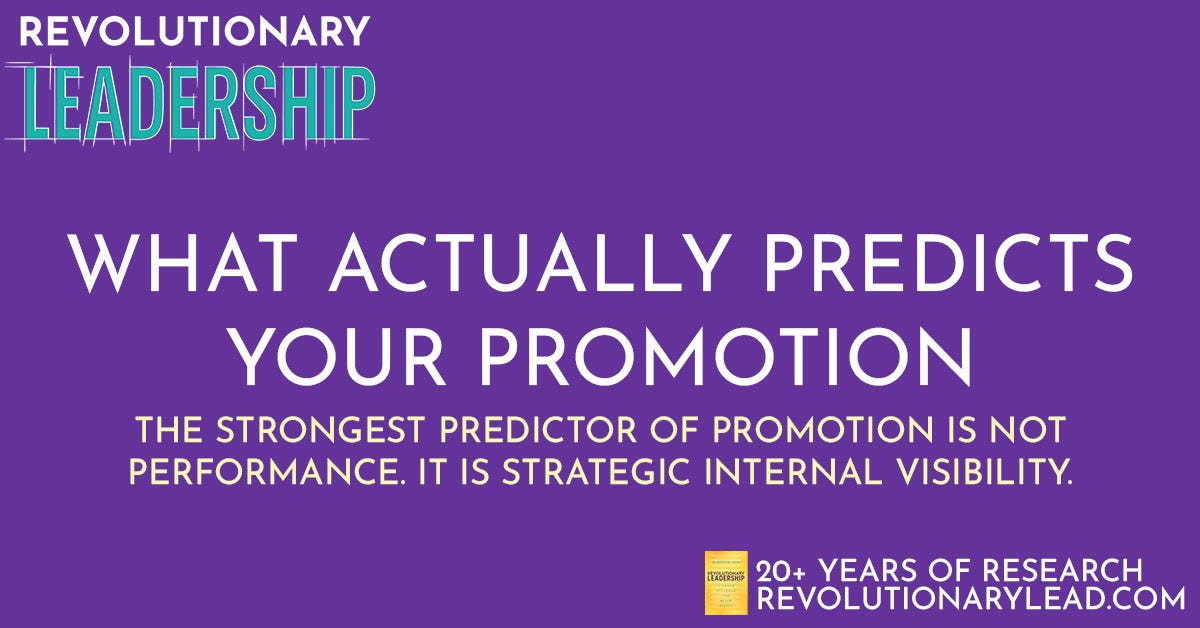
The strongest predictor of promotion in my data was not effort. It was not performance ratings. It was not external visibility — the conference keynotes, the published articles, the public profile that every career book had told me to build.
The strongest predictor was something the field had barely named.
Internal visibility. Being seen by the people who make decisions. Doing high-stakes work inside the organization where your career actually lives.
And here is the part that stopped me: external visibility — the thing we are all told to chase — showed weak or negative relationships with promotion. In several of my model specifications, the relationship was negative. Not neutral. Negative.
I looked at it again. I ran it differently. I asked my advisor. The pattern held.
Fifteen years later, in 2025, I returned to that same professional population with the same core questions. Over 600 Black women across both studies now. A world transformed by COVID, racial reckoning, and the rise of remote work.
The pattern held again.
I call this the Visibility Paradox, and it is one of eight frameworks in Revolutionary Leadership: A Power Playbook for Black Women, publishing August 4 through Entrepreneur Books.
I want to walk you through it, because you should know what the research actually says before you decide whether the book is for you.
What the Paradox says
Most career advice collapses the distinction between two different things.
The first is the visibility that builds your public reputation. The conference you keynoted. The article in Harvard Business Review. The LinkedIn post that went viral. The podcast interview. This is external visibility, and it is real — it builds your market value, your speaking fees, your ability to move between organizations.
The second is the visibility that shapes advancement decisions inside a specific organization. Whether the senior vice president knows your work. Whether you are on the high-stakes project when it matters. Whether the decision-makers in your company see you solving the problems that keep them up at night. This is internal visibility, and it is structurally different from the first.
The career advice industry acts as though these are the same thing. The data says they are not.
What I observed in twenty years of practice
Before I had the research, I watched this pattern unfold in every workplace I was in and with client engagements.
A woman would come to me frustrated. She had done everything the career books said to do. Published. Spoken at conferences. Built a LinkedIn presence. Got quoted in trade press. And she was not advancing.
When we looked at her situation carefully, the picture was always similar. Her external profile was strong. Her internal positioning was thin. The senior leaders who controlled her next promotion did not know her work in any specific, memorable way. She was known everywhere except where it mattered most.
She had been doing the right things for the wrong audience.
This is not a moral failing. This is a mismatch between where career energy is invested and where career advancement is decided. And for Black women, it is a mismatch with specific consequences — because organizational environments do not always make internal access easy, and the energy spent on external visibility is often energy not available for the harder, slower work of internal positioning. The women who built the leadership infrastructure of the Black church, the mutual aid society, the civil rights movement understood internal positioning before anyone named it. They knew which rooms held the decisions, and they built their work to be visible inside those rooms even when the rooms had locked them out. The pattern in the data is not new. The research caught up to what generations of Black women already knew.
Over 600 Black women across two longitudinal studies, 15 years apart. The patterns were not random. They were structural.
What the Paradox does not say
I want to be careful here.
The Visibility Paradox is not an argument against external visibility. I have a public platform. I have published. I speak at conferences. I believe in the value of that work — for thought leadership, for reaching audiences who need the research, for building the kind of credibility that outlasts any single organization.
The Paradox is an argument against mistaking external visibility for internal positioning. They are different investments with different returns. Both matter. But they are not interchangeable, and collapsing them is one of the most expensive mistakes career books have taught us to make.
What the book does with it
In the book, the Visibility Paradox gets its own chapter. The chapter lays out:
-
The specific regression findings from both studies, translated into language that does not require a statistics background
-
A diagnostic exercise to assess where your current visibility energy is actually directed
-
A reallocation framework for rebalancing internal and external investment based on your career stage and organizational context
-
Case examples from my consulting practice showing how the reallocation plays out in real decisions
The Pre-Launch Workbook, which everyone who pre-orders before August 4 receives, contains a shorter version of that diagnostic. You can start working with the framework before the book arrives.
Why I am telling you this now
The Visibility Paradox is one of eight frameworks in the book. You will find it in Chapter 8, under Revolutionary Visibility, in Part Two: Strategic Power.
If this one finding changes how you think about your own career strategy — if it makes you reconsider where the next six months of professional energy is actually going — the book has seven more frameworks like it. Each one grounded in the research. Each one tested against twenty years of practice. Each one designed to be used, not admired.
If this is what you have been looking for, pre-order the book. If you have not decided yet, keep reading the Substack. The research series starts next Monday — five issues over five weeks, each one previewing a different finding from the same body of work.
The book publishes Tuesday, August 4. Pre-order at revolutionarylead.com. Forward your receipt to DrKerry@RevolutionaryLead.com and the pre-order bonus package — including the workbook — comes to you within a few days.
Lead with power. Lead with care. Change everything.
Revolutionary Leadership: A Power Playbook for Black Women publishes August 4, 2026. Pre-order at revolutionarylead.com.
Listen to the podcast on Apple Podcasts, Spotify, Amazon Music, Castbox, or YouTube.
Join The Blueprint Circle — founding membership $120 for life, capped at 100 members. After that, it closes permanently. revolutionarylead.com