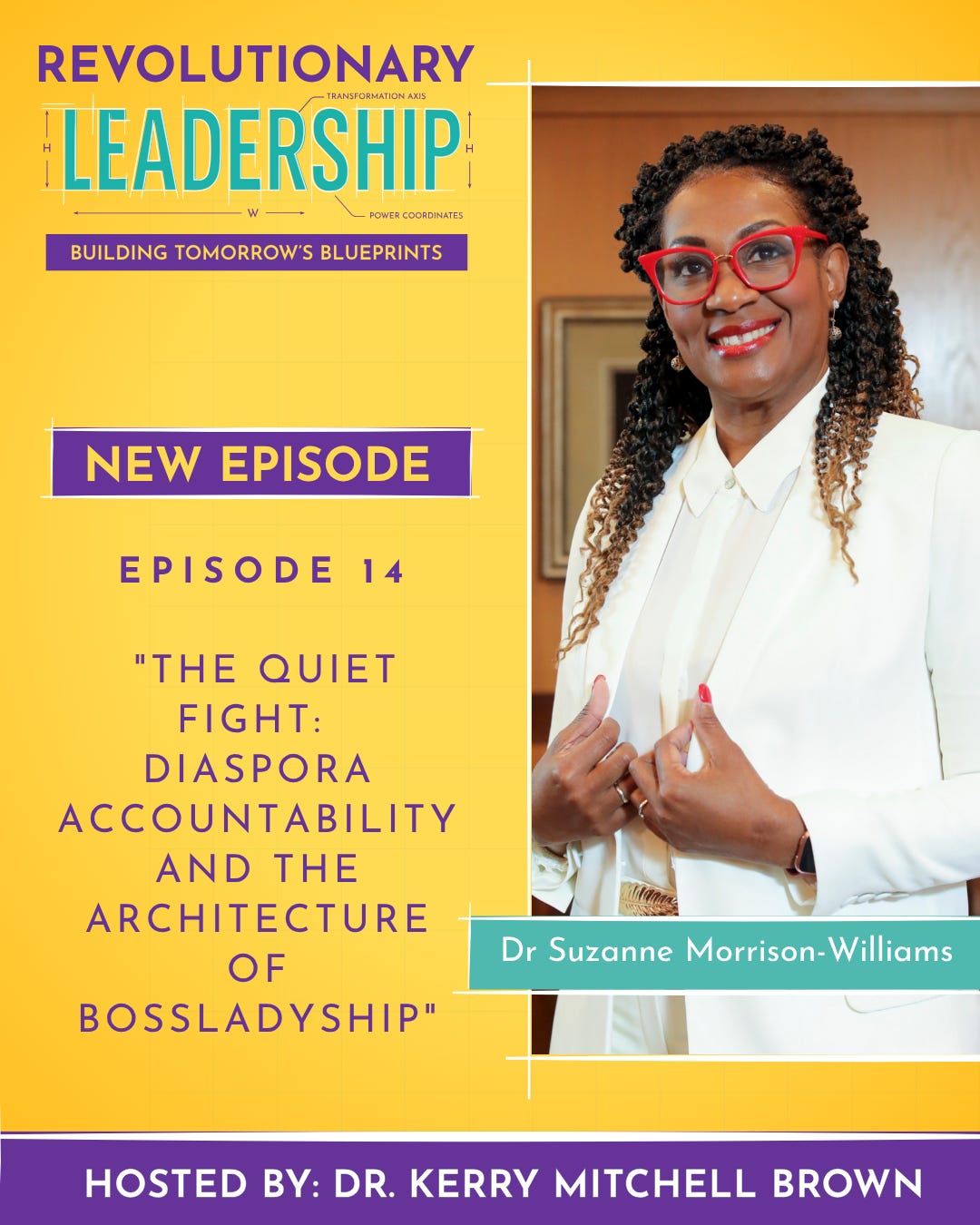
Most leadership conversations about the Black diaspora stay safe. They celebrate what we share. They avoid what divides us. They do not name the systems that use our differences against us.
This episode names them.
“Any immigrant who is honest is going to tell you that we will step on top of the people who created the framework for us in order for us to move forward.” — Dr. Suzanne Morrison-Williams
The conversation
-
Black women make up nearly 8 percent of the US population and hold just over 1 percent of top executive leadership roles. That gap is not a pipeline problem. It is a recognition problem. The frameworks were always there. The recognition was not.
-
But there is another layer. Inside the systems that suppress Black women’s leadership, there is a mechanism that uses immigrant women of color as a wedge — treating Caribbean women differently, rewarding the accent, perpetuating the story that the problem is Black American women’s performance rather than the system’s design.
-
Dr. Suzanne Morrison-Williams named it. And then she named what accountability requires once you see it.
-
Dr. Sue is a Jamaican-born executive leader who has navigated every level of the American higher education ladder. Faculty. Director. Dean. Campus president. Regional vice president. Vice provost. She is currently Chief Academic Officer at LIRN, a nonprofit consortium serving over 350 educational institutions. Certified success coach. Author of BossLadyShip: Color Me a #BossLady. Co-founder of Sisters Breaking Glass Together, Inc. Doctorate in Organizational Leadership.
Listen to the podcast
Apple Podcasts • Spotify • Amazon Music • Castbox • YouTube
Movement 1 — BossLadyShip as a return to self
Dr. Sue did not write BossLadyShip to launch a brand. She wrote it to survive. During COVID, navigating a 19-year divorce and a career in transition, writing was the only thing that brought her back to herself. She described sitting in bed each night with a little purple laptop. Not thinking. Not editing. Just typing. Allowing the ancestors, as she put it, to guide the structure she did not yet have. The writing led her back to the little girl who started the journey. And from that return, a framework emerged that other Black women now stand on. The anchor is the architecture.
Movement 2 — The Jamaican matriarchy and the quiet fight
Jamaica is deeply matriarchal. But not obviously so. Jamaican women are raised to excel completely and support quietly. To move in silence while others claim the credit. To run the room while appearing to support the room. Dr. Sue calls it the quiet fight. Her mother was a vice president of human resources by the time Dr. Sue was ten years old. Her grandmother left Jamaica in 1952 as part of the Windrush generation, became a nurse in England, bought a house, then invited her husband to join what she had built. That is the lineage. Women who build while others deliberate.
Dr. Sue named the tension directly. Caribbean women sliding through and running the company while Black American women were doing the talking. She did not frame this as a critique. She framed it as a system that exploits the distance between them — and a diaspora that has the power to close it.
Movement 3 — The privilege of the accent and what it requires
When Dr. Sue opens her mouth in a room full of white men, the accent shifts the dynamic. The same content a Black American woman already said gets heard differently. The room turns toward her. She knows this. She named it publicly, without hedging.
“My name was called in a room that I was not in. It is my responsibility to call names of people in rooms that I am not in.” — Dr. Suzanne Morrison-Williams
And then she named the accountability. Every job she has gotten, she got because someone called her name in a room she was not in. Her responsibility is to call other people’s names in rooms they are not in. She describes going into conferences where her name is not on the program — and quietly underpinning the movement, pulling people into experiences they would not otherwise access, not needing the accolade, needing only the outcome. That is privilege as leadership practice.
Movement 4 — Still becoming
Dr. Sue entered 2026 with no clients, no goals, no vision board. She called it sitting in the flux until it appears. She stopped, not because she failed, but because her current course of action was no longer taking her to the outcome she wanted. And she trusted that the next version of herself would arrive. She described her current role — writing her own job description, doing only the parts of academia she loves, leading a new division — as the sliver of work that she can sustain and do brilliantly. The narrowing was not a failure. It was self-knowledge as a leadership practice.
“We have been taught to fear failure and not understand that failure is a pivotal part of being a human being. It keeps us accountable to our humanity.” — Dr. Suzanne Morrison-Williams
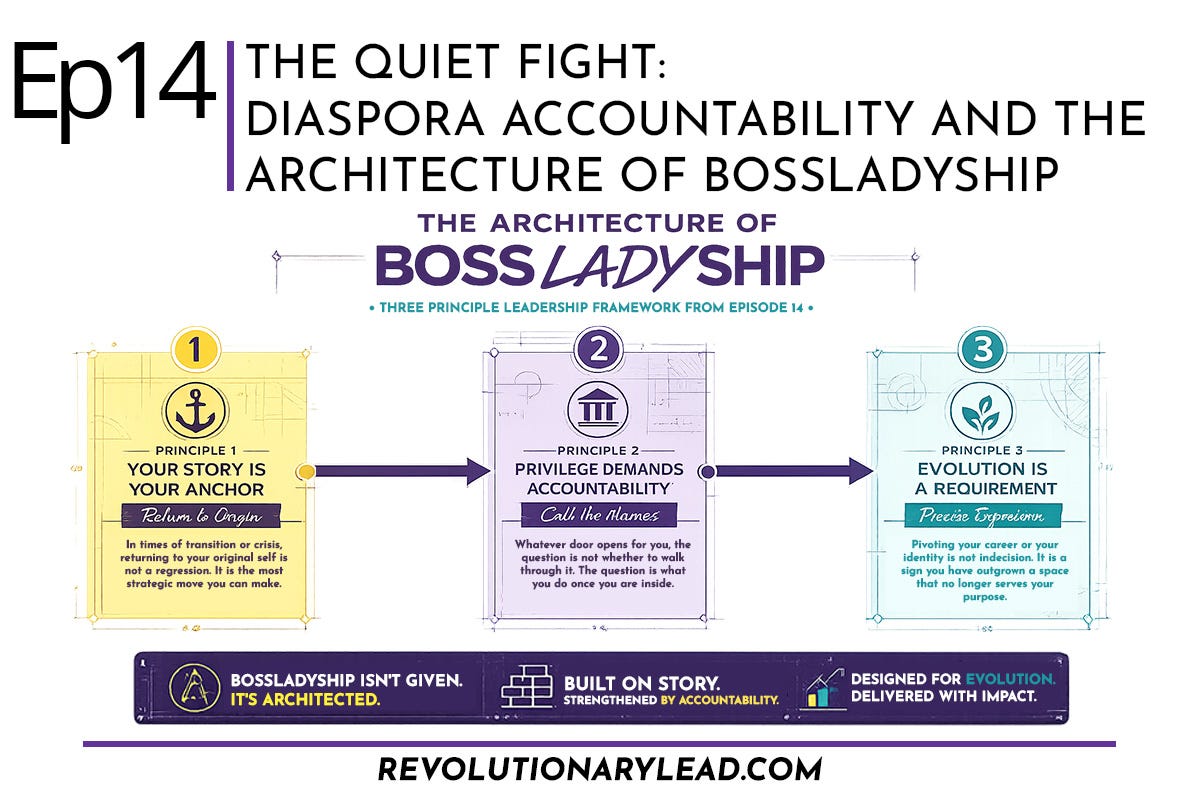
For Blueprint Circle members, the three principles Dr. Sue’s conversation surfaces — and how each one functions as leadership infrastructure rather than personal philosophy.
Revolutionary Leadership: A Power Playbook for Black Women publishes August 4, 2026. Pre-order at revolutionarylead.com.
Listen to the podcast on Apple Podcasts, Spotify, Amazon Music, Castbox, or YouTube.
Join The Blueprint Circle — founding membership $120 for life, capped at 100 members. After that, it closes permanently. revolutionarylead.com